


Advancing Equity-Informed Greenspace & Climate Action Planning
Enhancing the social, ecological, and climate resilience of communities through equity-informed greenspace and climate action strategies
Across Canada, communities are reimagining what it means for everyone to access and feel welcome in nature. Greenspaces – including municipal and regional parks, conservation areas, urban forests, and green corridors – are increasingly recognized as essential infrastructure that supports public health, biodiversity, and climate resilience. Yet access to these spaces is not experienced equitably. As climate impacts intensify and urban populations grow, ensuring access to safe, inclusive, and biodiverse greenspaces becomes essential for community wellbeing and resilience. This raises an important question for many local governments: Where and how do we begin?
The Stewardship Centre for British Columbia (SCBC)’s new Greenspace for All: Resource Kit for Local Governments & Practitioners offers a practical starting point. Grounded in insights from the Greenspace for All (GS4A) Pilot Project, the resource presents actionable recommendations to incorporate equity into greenspace policy, planning, and implementation, along with local examples of successful programs and partnerships that are reducing barriers to accessing nature.
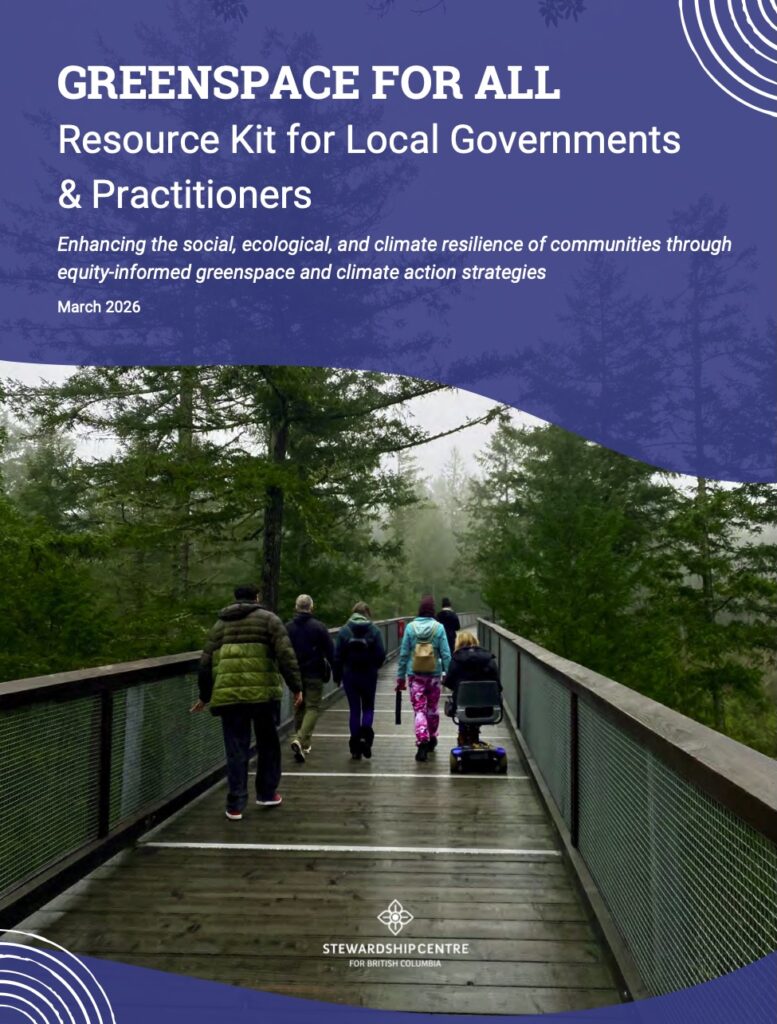
GS4A Resource Guide
Why Equity Matters in Greenspace & Climate Planning
Greenspaces deliver wide-ranging ecological, social, and climate benefits for the community. For example, greenspaces provide refuge during extreme heat events by reducing urban temperatures; soils and vegetation support biodiversity, absorb stormwater, and improve air quality; and time spent in greenspace fosters physical and mental health and social cohesion. However, historically marginalized communities – including low-income households, 2SLGBTQIA+, newcomers, seniors, racialized populations, people with disabilities, and women – often experience:
- Fewer and lower-quality parks and natural areas
- Limited tree canopy and greater exposure to extreme urban heat
- Access barriers related to cost, transportation, safety, or cultural inclusion
- Lower participation in environmental decision-making
Without an equity lens, climate adaptation and mitigation efforts can unintentionally reinforce these disparities. By contrast, equity-informed planning ensures that investments in nature-based solutions and climate resilience prioritize those who face the greatest barriers and vulnerabilities.
Inside the Greenspace for All Resource Kit
Designed for local governments, planners, and practitioners, the Greenspace for All Resource Kit offers:
- Practical recommendations and best practices
- Case studies highlighting GS4A project outcomes
- Success stories from local initiatives
- Resources for continued learning
Equity-informed planning calls for community-driven decision-making, meaningful engagement, and collaboration. The Resource Kit supports municipalities in moving from high-level strategic goals to measurable action by prompting critical questions, such as:
- Who currently benefits from greenspace investments?
- Which communities experience the greatest barriers to access?
- How can equitable access to greenspace be improved?
- What partnerships can help us co-create solutions?
By integrating equity into greenspace and climate strategies, local governments can build communities where all residents can connect with nature and share its benefits. The Greenspace for All Resource Kit offers a roadmap to advance this vision – supporting healthier, more inclusive, and climate-resilient communities across Canada.


